An Imperfect God
Christians and many other theistic traditions propose that their God is the ultimate of perfection. Not just the ultimate possible, but absolutely and truly perfect. In this post I’d like to explore the motivation and consequence of this point of view.
God is Really Really Big
We are mere mortals. We are a very small part of the creation. Clearly any kind of creator that might exist, any intelligent being who brought about the universe, is likely to be so much more capable than a human being. In a historical perspective as well as a contemporary one it’s reasonable to assume there any creator would be so far beyond the level of a human it would be hard for a human to even comprehend the vastness. To say that God was smart on a human level would obviously be an insult. Human intelligence is somewhat limited. I think we can see that without having to be super intelligent. The young child simply can’t understand what it means to be an intelligent adult. The relationship between man and creator would be even so much more so.
For me it’s simple enough to imagine a God who has vast intelligence so great that humans can’t even conceive of the implications. I comfortable with the idea that God might know more than all the human beings in existence put together. I can imagine a God that is billions of times more intelligent than human. But that’s far is short of knowing everything that is possible to be known.
Perfection
But the purveyors of Christianity go beyond simply saying that God must be unbelievably intelligent. They claim that God is more than simply the most intelligent being inside or outside the universe. They go all the way to claiming that God has perfect intelligence. (see references below) God knows absolutely everything about everything and can make perfect predictions about what will happen in the future. Omniscience is knowing absolutely everything that there is to know, and that there is absolutely nothing outside of what God knows.
Problems with Perfection
This is always struck me as quite sad. Imagine already knowing everything that it was possible to know. What could you possibly look forward to tomorrow? If you already know absolutely everything and can predict absolutely everything then you already know precisely what’s gonna happen tomorrow and the next day and the next. You would know this whether you like what is going to happen or dislike what is going to happen.
Imagine that you already knew exactly how each baseball team would play, how each teammate would act at every moment, and how every game would turn out: would you bother watching the season? Imagine how incredibly dull that would be to sit there saying “Oh, I knew that would happen!”
God would be entirely powerless to do anything about anything. God’s perfect knowledge would already have identified the optimal course of action whether you like it or not. They’ll be no wonder in the world. I don’t know if Gods desire to have wonder in their existence or not. There’s no need for goals because you already know exactly what’s going to happen and there’s nothing that you can do to change it. Maybe Gods have a perfectly high tolerance for boredom. But I can’t really imagine that is a very interesting.
Why Exist?
An omniscient God who knows everything would have no need to create a universe. Such a perfect God would already know how everything will turn out. There be no need to actually create anything. The only reason to create a universe would be to see how it turns out.
Even a god needs a reason to go on being.
Intelligence ➜ Learning
Intelligence refers to the ability to learn. Greater intelligence learns faster and more completely. The ultimate intelligence would surly have an unbelievably large desire to learn. But there would be absolutely nothing to learn. I can think of no torture greater than to be intelligent with no way to learn.
Imagine an intelligence that had no desire to learn. I can’t call that intelligence. Christians who claim that the universe was created by an omniscient intelligent being need to explain how intelligence can exist together with omniscience.
An omniscient god would be powerless to create any new “knowledge.” There is an idea that knowledge is truly unbounded because you can always combine what is known in a novel way to make something new that was not previously know. I really don’t think those who invented the term “omniscience” really thought through all the consequences.
It would seem almost inevitable that such an intelligence would desire to create a universe to learn what happens, and doing so would create new knowledge that could not have been known before.
Christian Contradictions
Christian theology also contradicts itself on this point. It claims that humans were given free will. Free will is the idea that a human can actually make a choice and that the choice was not pre-ordained by God. Christians often dance around this by claiming that God knows your nature, knows what you’re gonna do, but still doesn’t make you do it. I’ve always found this argument disingenuous. Any way you look at it mankind having free will means that God can’t be omniscient.
Also the concept of judgement is meaningless with an omniscient God. Christians say that God will judge your life and you will either pass into heaven or hell after death. An omniscient god has no real reason to “judge” at the end. If God already knew what Job was going to do, there would be no good faith reason to wager with Satan about it.
Why do Christians Need A Perfect God?
Help me out here, theists. So many Christians, and bible passages, insist that God must be absolutely perfect in all ways at the same time. Where does the need for this absolute come from?
If a Christian was to claim that God was less than perfect, what problem would arise from that? It would actually explain a lot of things about the world. In every conversation I have had with Christians, any suggestion that God was less than perfect was an absolute blasphemy. How dare you suggest that.
I guess a simplistic thinker might believe that a less than perfect god would lead open the possibility for a more perfect god. This might come from a naïve misunderstanding that something can not be a maximum without being at the absolute end of the scale. This simplistic thinker would probably not understand the concept of infinity either.
Some Christians say that God has to be more perfect than anything you can imagine, and being less than the absolute end of the scale leaves open the possibility that you might imagine something more perfect. For example, all exactly the same properties except killing one less baby in the flood.
My guess is that the Christian insistence on perfection is really just a way to shut down discussions of any other religion or god. "My God is absolutely perfect, and you simply can't get any better than that."
Can we Use Any Logic about God?
Logic is a tool that humans use to reason about the universe, but does that apply to God? In this case, the premises are simple:
P1: An omnipotent supernatural being is not constrained by time/space/rules of nature and can do anything, by definition.
P2: Humans do not know what, if anything, may be impossible for an omnipotent supernatural entity. Including existence.
C: The claim that an omnipotent supernatural deity is impossible, is logically incoherent.
This argument makes a good point. However it starts by reifying (objectifying) the action and the mere act of doing that make us think of the option to do or not. That leads us to confusion.
It is not that these rules of logic exist and the universe must conform to it. The other way around: we defined the rules of logic in a way that "works" with what we observe in the universe. We nevertheless make them up. They are made up with specific properties, and no God can change those definitions because they are what they are. It is not like this is a "thing" that the God has been prevented from doing, there just is no such thing to do.
Simplest case. You can't make 1 not equal to 1. That is the definition of one and the definition of equals, and you can't say that 1 does not equal 1 because they equal by definition. If you could say they are not equal, you would be talking about a different definition of equals. You could redefine "equals" but then you would not be saying the thing above I said can not be done.
These sorts of things (like making a married bachelor) carry in their meanings the exact things that make it impossible. Bachelors can't be married by definition. If someone is married, then they are not a bachelor. I don't need to assess the power of any God because it is not possible by definition.
A similar mistake is made when one proposes that "existence" is a property.
For example, Spiderman has a property of existence that is either true or false. By stating it this way, you objectify Spiderman into a position of "possible existence". Constructing the problem in this way distorts the thinking. The real world is Spiderman with the existence flag set to false, but it opens the possibility that there could be a universe where Spiderman has the existence flag set to true.
The problem is that existence is not a flag that can be false. If something does not exist, then there is nothing to put the flag on. This is precisely the flaw that is used to make the ontological proof of God seem reasonable.
An Imperfect God
It is more reasonable to think of a god as an intelligent being on a voyage of discovery. The creator of the universe acted in this way to see what would happen. This God created a universe with a set of well-known initial conditions. What would not have been known to god is exactly how the universe will unfold. Seeing it unfold is the very reason for creating the universe in the first place.
What if God had the desire to improve itself? Self improvement would seem to be a quality of any intelligent thing. You can only improve if you are not perfect.
Seeing the universe as an experiment would give God a reason to go on being. It gives the creator a reason to create. This explains perfectly the Christian concept of free will, that God can not know exactly what choices people will make, and therefor has a reason possibly to judge them at the end of their lives.
Sacrilege! How dare I imply that God is not perfect? I can hear them prepping the thumbscrews now. I can understand how religious zealots would want to claim God had perfect knowledge. When the Bible was written there were many competing religions, and many competing gods, it was important for missionaries to describe why their god was better than the others. It is complicated to describe a god who is vastly more intelligence than humans, but still slightly less than perfect. I can see how an admission of any imperfection would open the door to questions that are so hard to answer. Just claim perfection and pass the basket. So I can understand how these ancient stories formed and why religious leaders promoted them — but I find these reasons unconvincing.
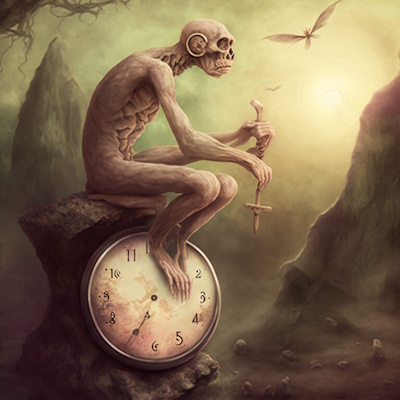
Evidence for a Learning God
The universe appears able to produce self-organizing structures. This might be enabled because of an ingenious balance between the fundamental forces that allow atoms to exist, and molecules to form. Or it might be pure chance. In either case, the flow of energy itself allows larger and larger organizations to come into existence. Stars form, galaxies form, planets form, continents form, mountains and oceans form, life forms, neural information processing forms, consciousness forms, and there are still higher structures being created. All of this is due to the properties of the universe. But what actually resulted is an unpredictable outcome of the interaction of everything in the universe.
What I’m suggesting is that the universe is an experiment. God essentially said: let’s see what happens if I make the balance of the various forces in this way. And in doing so, God created new forms of being. Self-organization is the cause of entirely novel things to exist. These things coming into existing are in fact new things that God comes to know. By creating a universe, new knowledge is created, and in fact this is the only kind of increase that can actually be called creation. As the universe grows, as all the experiments are run, God itself grows.
Caution: Maybe I’m being too anthropomorphic. After all, I’m using my intuition about what a god might or might not want. My own human desires are honed by the need to survive. There’s no reason to believe that a God who’s survival is not contingent would have any of the same cares or desires that I have. I mindful of that so all of this has to be taken with a grain of salt. Still, my arguments are based solely on the meaning of “intelligence.”
Creation is Never Done
The idea of Material Positivism and Poetic Naturalism compel me to the idea that God is not done with the universe. Omniscience would be a dead universe. Our universe is very much alive. It is forming new things every day. God imbued the universe with this nature. God is growing because the creation is not done creating.
And . . . we are part of it.
References
- God’s Knowledge Is Perfect – Bible.org
- The Perfect Knowledge of God – Via Emmaus
- God’s Perfect Knowledge – Psalm 139, The Redeemed Mind